Sports Vehicles

Concept Cars

Strange Vehicles

Home > Sports vehicles > Land vehicles > Motorbikes > BMW S 1000 RR

BMW S 1000 RR


BMW S 1000 RR

BMW S 1000 RR

BMW S 1000 RR

BMW S 1000 RR

BMW S 1000 RR

BMW S 1000 RR

BMW S 1000 RR

BMW S 1000 RR

BMW S 1000 RR

BMW S 1000 RR

BMW S 1000 RR

BMW S 1000 RR

BMW S 1000 RR

BMW S 1000 RR

BMW S 1000 RR

BMW S 1000 RR

BMW S 1000 RR

Year (of specifications) 2009
Engine 999 cc, straight 4 cylinder
Transmission 6-speed, chain
Max speed -
0-60 mph -
Horsepower 193 hp @ 13,000 rpm
Weight 206.5 kg / 455 lbs (with ABS)
Seat height 820 mm / 32.3 inches
Add a review or information on this vehicle

BMW introduced the road going version of their S 1000 RR race bike in May, 2009 at the Monza Racing Circuit.

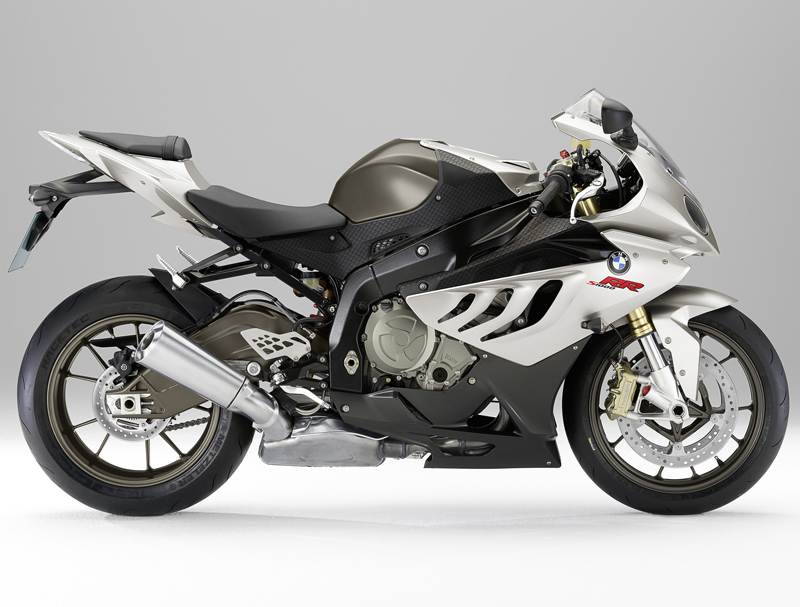
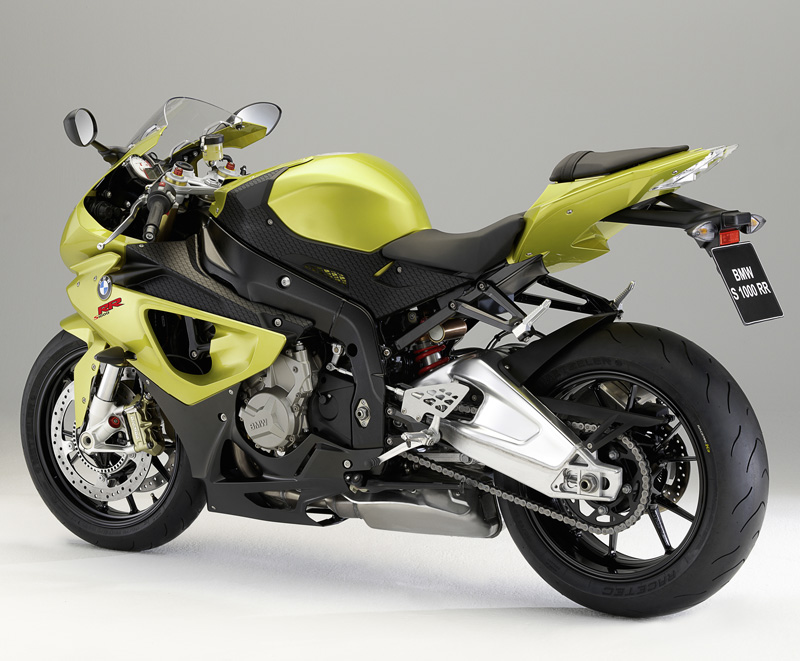
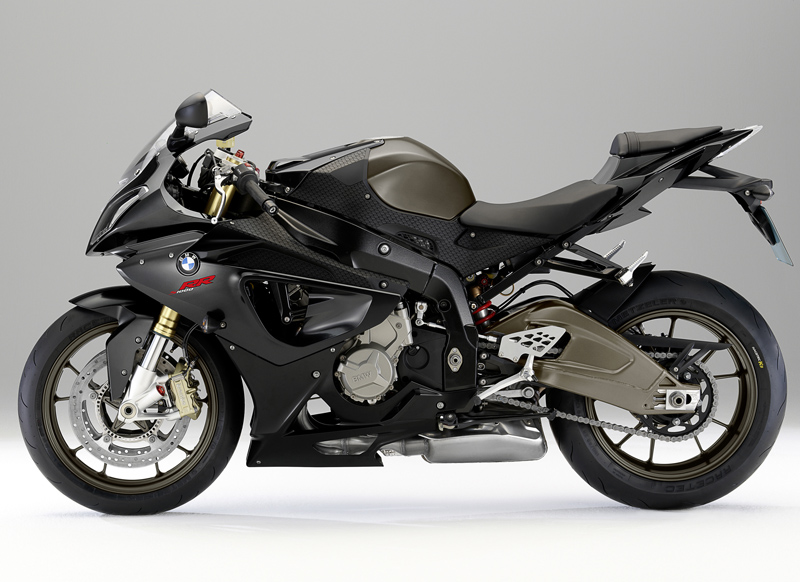
Highlights of the BMW S 1000 RR include unique and striking bodywork which is noticeably different on either side, and a tremendously powerful four cylinder engine. Powering the bike is a 999cc, inline four-cylinder engine which develops 193 horsepower @ 13,000 rpm and 112 Nm (83 lb-ft) of torque @ 9,750 rpm. This is mated to a six speed gearbox with dog-type shift.

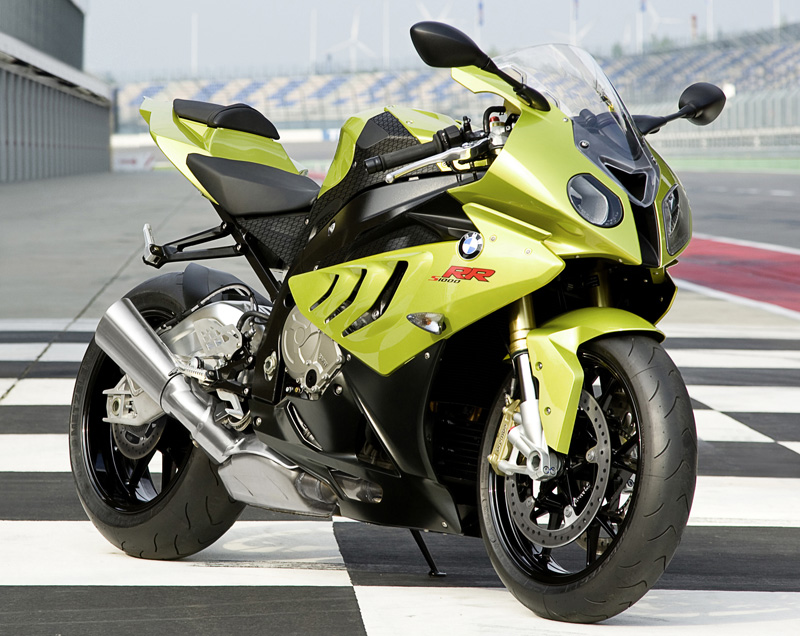
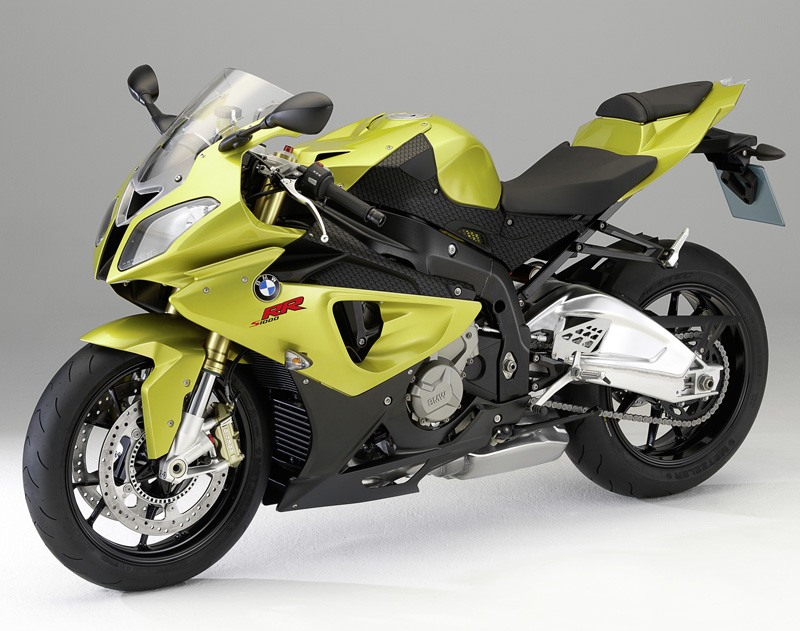
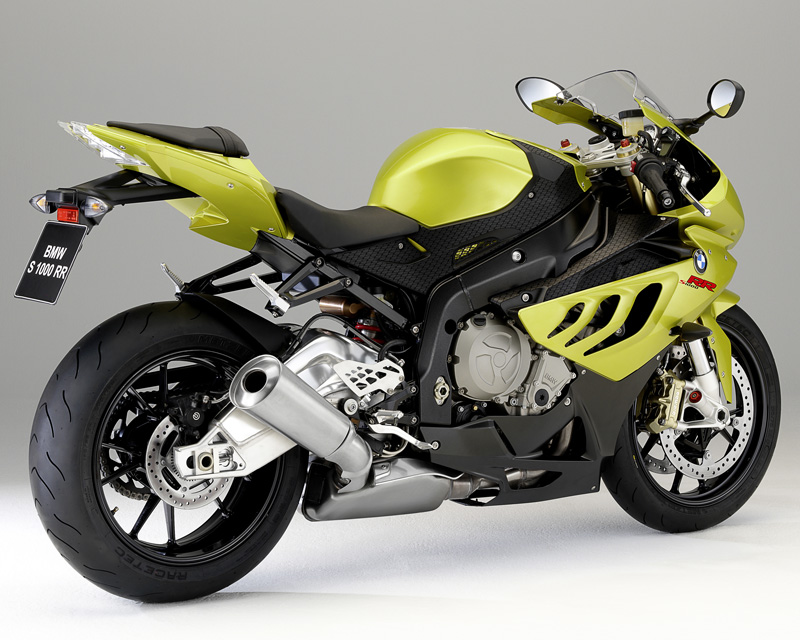
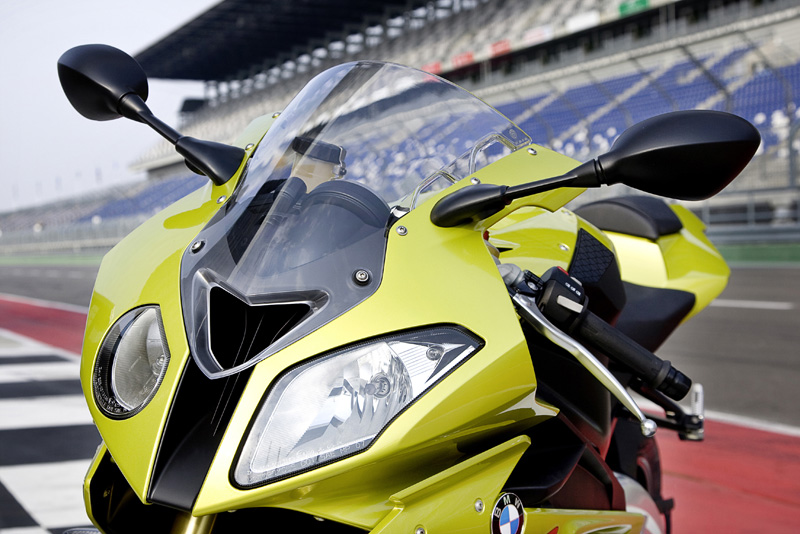
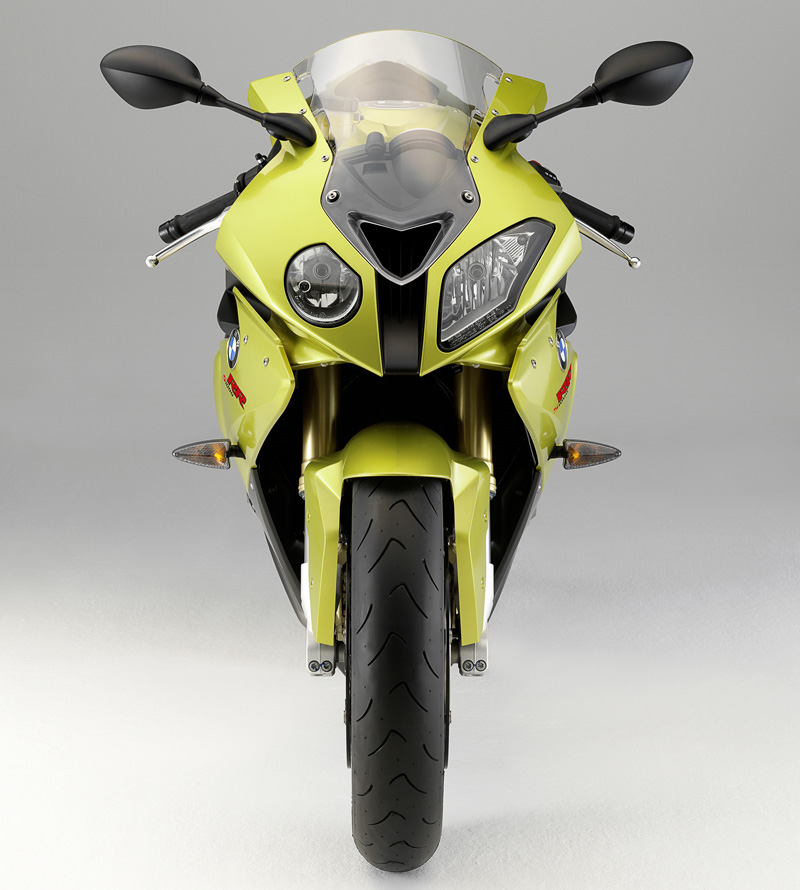
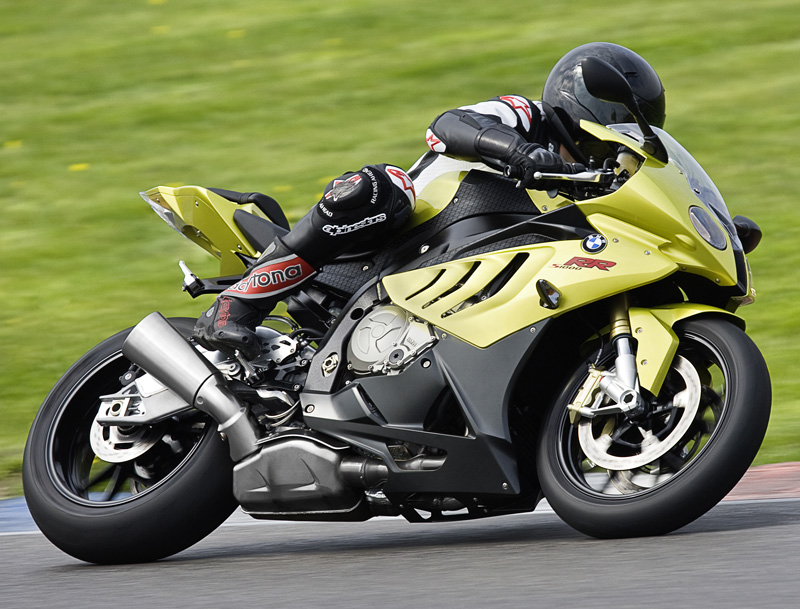
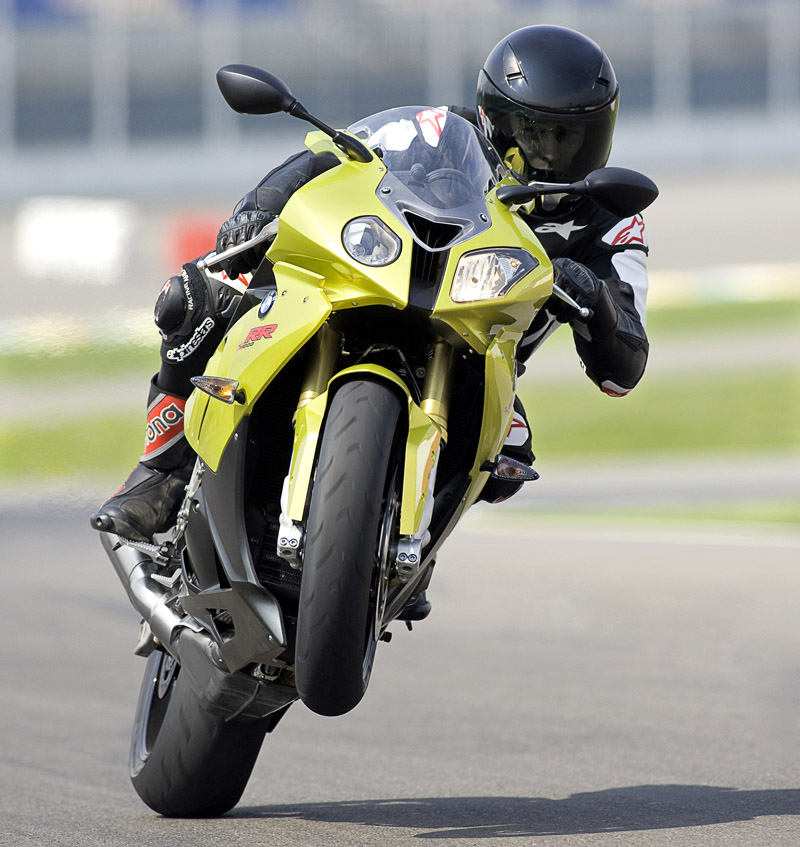
The front view of the S 1000 RR is especially of interest due to the unsymetrical headlight layout which although unique could hardly be described as beautiful, it looks like a winking ogre.

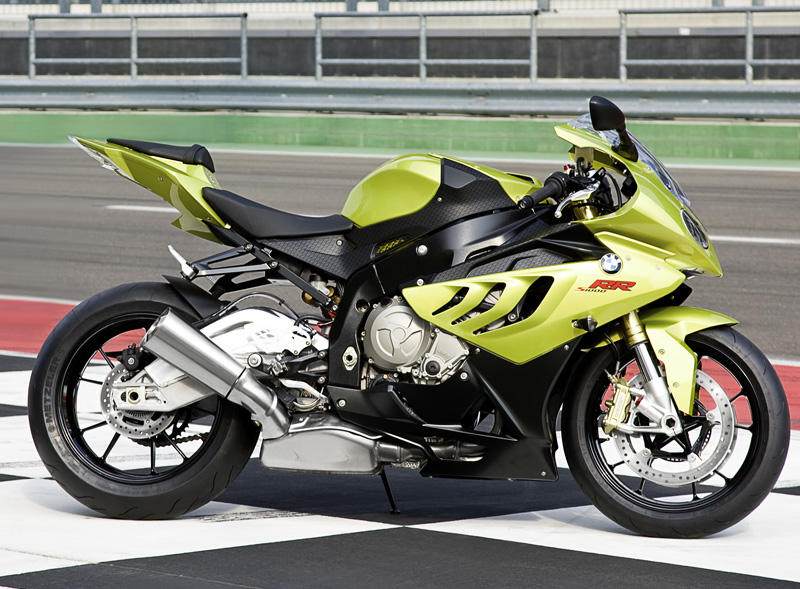
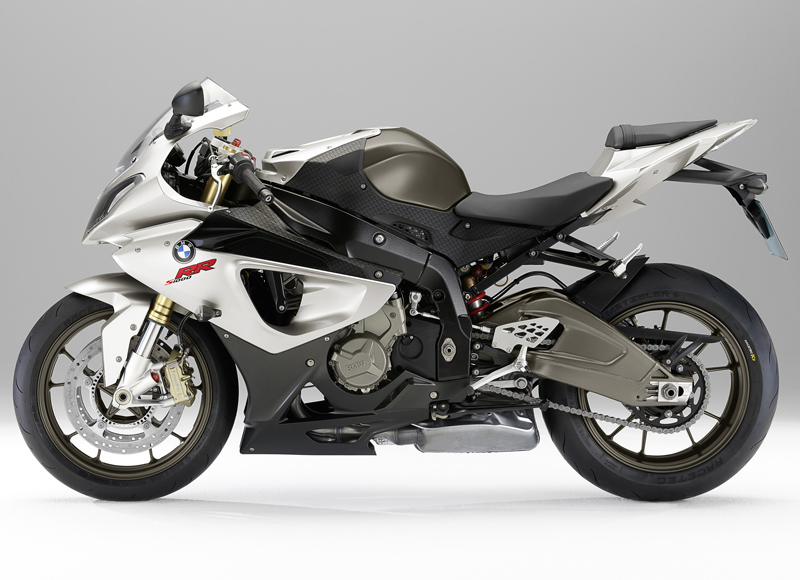
Other noticeable styling choices include the different left/right side fairings. On the left is a single large air outlet, while on the right hand side are three air vents which appear similar to the gills on a shark.


BMW Press Release:

Unique against the competition
Over the years and decades, the principle of combining a straight-four power unit with an aluminium bridge frame has been consistently developed and has become the dominating technical concept particularly in the supersports segment. The reason, quite simply, is that a motorcycle of this kind offers significant benefits in terms of riding dynamics, long-distance endurance, and straightforward production.


Maximum performance and riding dynamics.
The consistent concept of the S 1000 RR supersports is borne out in particular by the truly fascinating, innovative high-performance technology and incomparable riding dynamics of this new machine. The result is an exceptional combination of supreme riding precision and agility, on the one hand, with unparalleled engine power and performance on the other.


Free choice of engine characteristics as well as Race ABS and DTC Dynamic Traction Control
The new BMW S 1000 RR also excels through features and qualities typical of BMW such as a long running life, superior quality of production and optimum environmental compatibility thanks to the use of the most advanced exhaust management with two fully controlled three-way catalytic converters also able to fulfill future standards and requirements.

Active safety when braking is significantly enhanced by Race ABS developed especially for the BMW S 1000 RR as a genuine supersports and available as an option straight from the factory. A further most significant feature likewise contributing to active safety of the highest standard is DTC Dynamic Traction Control also available as an option and masterminded electronically for supreme precision and practical value.

Facing various riding conditions such as wet roads (“Rain”), regular road conditions (“Sport”), a race track with supersport tyres (“Race”), or a race track with slicks (“Slick”), the rider also has the choice of various engine characteristics and setups available at the touch of a button. And last but not least, Race ABS and Dynamic Traction Control are combined with the respective riding modes and coordinated with one another to ensure a supreme standard of performance and safety all in one.


Valve drive like in a BMW Formula 1.
The primary objective in developing the new S 1000 RR was to create a supersports with supreme engine power combined with optimum rideability for the highest conceivable standard of all-round performance.

The water-cooled four-cylinder inline power unit chosen to provide these qualities is brand-new from the ground up, developing maximum output of 142 kW (193 hp) at 13,000 rpm and revving up to a maximum speed of 14,200 rpm. Maximum torque of 112 Nm (82.5 lb-ft), in turn, comes at 9,750 rpm.

Following the example of BMW ’s Formula 1 engines, the two intake and exhaust valves per cylinder made of extra-light titanium are operated by very small and equally light single cam followers. In conjunction with the short sprocket driving the camshaft via an intermediate gear, this ensures supreme revving qualities at the highest speeds as well as exact maintenance of valve timing combined with very compact dimensions.

The use of extremely small and light cam followers furthermore gives the engineer greater freedom in choosing the ideal valve lift curves and, accordingly, in selecting optimum performance characteristics on both road and track.

All engine components are particularly compact and light, limiting weight of the overall engine without ancillaries to 59.8 kg (131.8 lb) and keeping the entire power unit very slim and slender.


Innovative exhaust system with interference pipe butterflies for optimum power and performance.
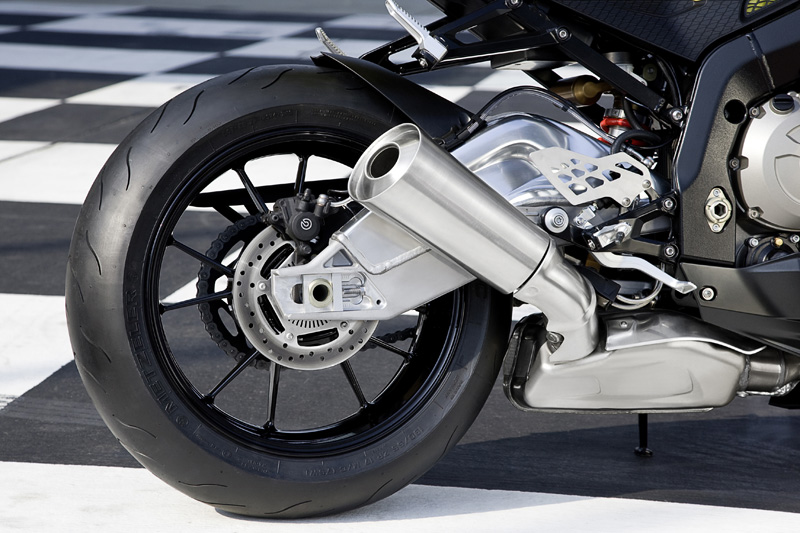
Made completely of stainless steel, the exhaust system featured by the S 1000 RR is designed consistently for optimum power and performance. It works according to the 4-in-2-in-1 principle with four individual manifolds of equal length first merging into two pipes beneath the engine block and then extending into a large-volume pre-silencer. From there the exhaust emissions flow through a very short and dynamically designed rear-end silencer to the outside.

A homogeneous power and torque curve ensuring optimum rideability is acknowledged as the requirement for sporting performance on the road and fast lap times on the track. Precisely this is why the exhaust system featured on the S 1000 RR comes with two fully controlled interference pipe butterflies housed in two connection pipes for the two outer and two inner manifolds, in the immediate vicinity of the exhaust ducts. As a function of various parameters such as engine speed and the position of the throttle butterfly, an adjuster opens or closes these flaps, allowing exhaust gas to flow freely between the two manifolds or, respectively, interrupting the fl ow of gas. This coordinates the sequence of oscillations in the exhaust gas mass flow, reducing exhaust gas counter-pressure at the decisive point (like on a racing muffler) and increasing the cylinder charge accordingly.


Putting the rider right in the centre.
The rider’s seating position leaning forward towards the front wheel for an active style of riding is simply ideal for the sporting rider with his particularly dynamic style.

Developing the S 1000 RR, BMW Motorrad has given particular attention to the superior ergonomics of the machine, providing ideal qualities for both small and tall riders and therefore focusing consistently on the rider’s individual requirements. The tank section is as slender as on a 600-cc machine, giving the rider the assurance of excellent control and handling at all times


High-output four-cylinder inline power unit for maximum performance.
As an absolutely new development from the ground up, the straight-four power unit featured in the S 1000 RR comes with displacement of 999 cc, with cylinder bore of 80 millimetres or 3.15" and stroke measuring 49.7 millimetres or 1.96". The particularly short stroke/bore ratio of just 0.621 provides the foundation for an absolutely outstanding high-output power unit with supreme performance at all times.

Maximum output is 142 kW (193 hp) at 13,000 rpm, peak torque is 112 Nm (82.5 lb-ft) at 9,750 rpm. So again, the power unit of the S 1000 RR sets new record standards in the supersports 1000-cc class also in this respect.

Optimum riding dynamics and supersports features combined with optimum rideability and compact dimensions together with minimum weight were the primary targets in developing the new drivetrain. And with its engine weighing just 59.8 kg (131.8 lb), the S 1000 RR boasts the lightest 1000-cc four-cylinder in its entire segment.

Like all engines from BMW Motorrad, the power unit featured in the BMW S 1000 RR excels through its supreme overall concept as well as the space-saving arrangement of all ancillaries and the integrated six-speed gearbox with its dog-type gearshift. Following the brief to build a thoroughbred supersports power unit, the engineers at BMW Motorrad have created a particularly compact engine with ideal concentration of masses around the machine’s overall centre of gravity. Despite the large cylinder bore of 80 millimetres or 3.15", engine width at crankshaft level is only 463 millimetres or 18.23". And at 558 millimetres or 22.0", the engine is also very low in terms of its overall height.

Free choice of “Rain”, “Sport”, “Race” and “Slick” riding modes for optimum adjustment to road and track conditions.
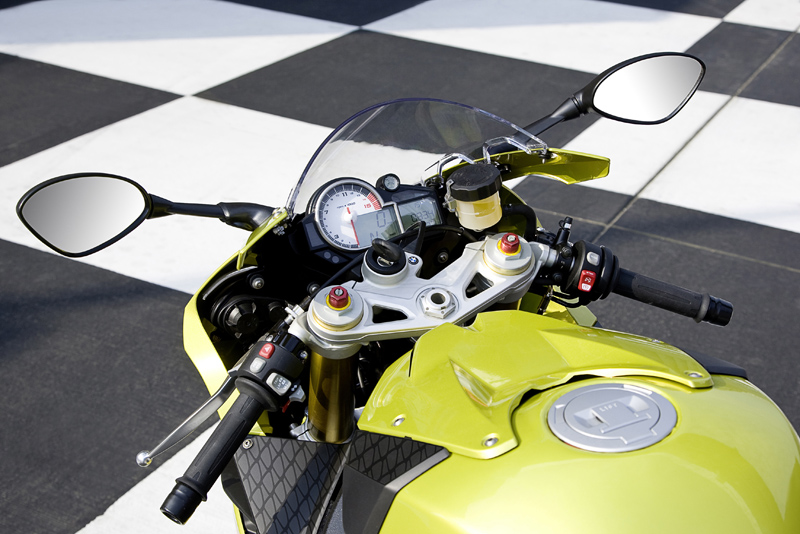
At the simple touch of a button at the end of the right handlebar, the rider is able to choose among various riding modes for all kinds of different conditions and requirements such as riding on the road, on a wet surface, or the race track. To make his choice, all the rider has to do is press the Mode Switch on the right handlebar control unit until the display in the instrument cluster reaches the mode desired. Then, pulling the clutch lever and turning the gas handle to idle, the rider is able to confirm his request also while riding and the mode is switched accordingly.

The mode last chosen is always retained when restarting the motorcycle.

When riding on a wet surface with reduced grip, the Rain Mode automatically reduces maximum output to 110 kW (150 hp). This mode also provides a particularly homogenous power and torque curve, with engine response and power build-up by the engine being extra-smooth and soft.

When riding on a dry surface the Sport Mode provides full engine output of 142 kW (193 hp) in combination with even more spontaneous and direct response to the gas lever. This mode is intended above all for use on country roads.

The Race Mode has been developed specifically for racing the S 1000 RR on race tracks using street-legal supersports tyres. Here again the rider benefits from the full power of the engine, with an even more direct and significantly more dynamic response at all speeds.

The Slick Mode is intended exclusively for racing on the track using slick tyres. Like the Race Mode, this mode not only provides full engine power, but also ensures maximum engine response for racing or riding under race-like conditions. Contrary to the Race Mode, the Slick Mode allows DTC Dynamic Traction Control to cut in permanently only from a side angle of 200. This, in turn, allows the rider to wheelie for up to five seconds when leaning over to an angle of less than 200, ensuring optimum acceleration and pulling force when accelerating out of a bend.

While the three modes Rain, Sport, and Race are activated by the rider directly from the end of the handlebar, the Slick Mode comes with an activation lock function provided by a code plug for the control unit beneath the rider’s seat of the S 1000 RR.


Innovative suspension technology for supersports performance of the highest standard.
Through its consistent concept, the BMW S 1000 RR, as a genuine supersports machine, offers not only the most outstanding drivetrain technology for optimum performance at all times, but also comes with truly exceptional riding precision ensuring unparalleled riding dynamics and almost playful agility. So the suspension and running gear of the S 1000 RR likewise offers the highest standard of excellence and sporting performance.

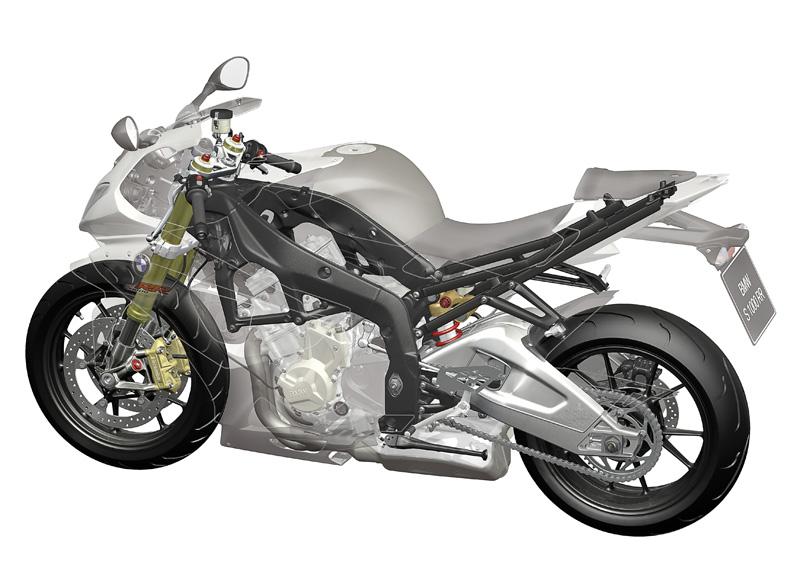
The “heart” of the suspension is the aluminium bridge frame weighing just 11.98 kg (26.42 lb), tilting the engine to the front at an angle of 32° as a load-bearing element.

While this type of frame is already state-of-the-art in large sectors of the supersports segment, the engineers at BMW Motorrad, in developing the S 1000 RR, focused consistently throughout the entire process on the need for maximum riding dynamics. And particularly through their close communication and cooperation with the departments responsible for drivetrain development and design, they ultimately created a suspension and running gear setting new standards in many respects.


Aluminium bridge frame with the engine serving as a load-bearing element.
The result of this development process is an aluminium bridge frame made up of four castings. This particularly configuration serves above all to meet the great challenges in designing a motorcycle with a very slim waist and a large airbox. The spread of stiffness values follows a wide range of calculations and simulations as well as many riding tests taking all kinds of variants into account.

The steering head and the two side sections with their integrated engine mounts are manufactured in a tip casting process, while the rear section with the rear engine mount, the swing arm supports as well as the mounting points for the footrests and kinematic elements are made in a low-pressure die-casting process. A high-precision welding robot then assembles the individual components in the Aluminium Competence Centre at BMW Motorrad’s Berlin Plant to form an extra-stiff and sturdy unit all round.

The rear frame section on the S 1000 RR is a welded structure made up of square aluminium profiles bolted on to the frame. Again, this combines low weight with superior stability and robust strength appreciated particularly by competition riders and teams on the race track. A further advantage of this configuration is that it allows optimum access to the spring strut, for example when changing the set-up for specific requirements.


Fully adjustable spring elements with very high damping reserves.
Seeking to give the new S 1000 RR optimum suspension qualities with perfect running gear, the engineers and specialists at BMW Motorrad decided to give the new machine a central spring strut with an adjustable spring base as well as adjustable damper inbound and rebound control. A further advantage is that this configuration allows the adjustment of low-speed damping (for example on long, stretched-out undulating surfaces) and high-speed damping (eg on short bumps) on the pressure stage (inbound), thus offering perfect set-up qualities with maximum precision.

The spring strut is activated by compact and light kinematic levers and makes allowance for the wide range of use also on the race track by offering a wide range of adjustment as well as very substantial damping reserves.

Overall spring travel on the rear wheel axle is 130 millimetres or 5.12", with 90 millimetres or 3.54" positive and 40 millimetres or 1.57" negative spring travel.

Using eccentric inserts on the upper spring strut support, the rider is able to raise the entire rear end of the S 1000 RR by 10 millimetres or 0.39" on the spring strut support, thus taking his individual requirements and the specific character of the respective route into account.

The S 1000 RR meets equally high demands in terms of riding dynamics also on the front suspension. The configuration used up front is an upside-down fork with its fixed tube measuring an ample 46 millimetres or 1.81" in diameter. This size alone is quite unique in the supersports segment, offering far greater braking stability and better feedback than the usual fixed tubes measuring 43 millimetres or 1.69" in diameter.

The fixed tube is mounted on the steering head by a light aluminium steering shaft tube running in two extra-large ball bearings as well as two fork bridges made of forged aluminium in the interest of minimum weight. To adjust the height of the motorcycle at the front to the personal needs and preferences of the rider as well as the route he is taking, the immersion tube at the front provides an appropriate overlap, overall adjustment travel of 15 millimetres or 0.59" allowing the front end to be lowered by up to 5 millimetres or 0.197" and raised by up to 10 millimetres or 0.394".

The upside-down fork comes with cartridge inserts inside, that is a separate hydraulic piston cylinder system, and allows adjustment of both the spring base as well as damper rebound and inbound action. Here again, the sensitive behaviour and response of the suspension, the wide range of adjustment and very significant damping reserves even on the race track offer superior flexibility and individual choice. Overall spring travel is 120 millimetres or 4.72", with 75 millimetres or 2.95" positive and 45 millimetres or 1.77" negative spring travel.

To allow simple and reliable control at all times, the individual settings on both the spring strut and the upside-down fork are clearly specified by numbers ranging from 1 to 10. So there is no need to count up to 30 clicks in the usual tedious process required on some other models in this segment.


Multi-functional instrument cluster with racing features.
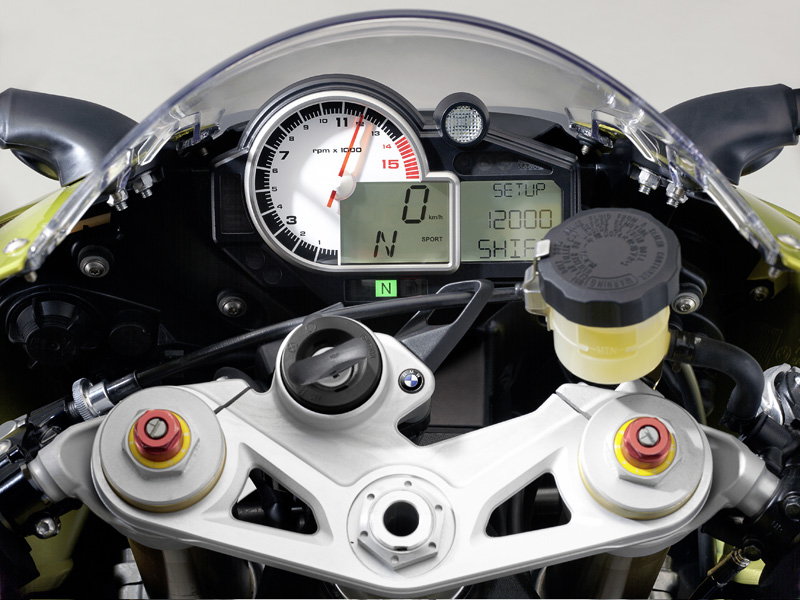
The instrument cluster comes with a large, easy-to-read LCD display as well as an analogue rev counter also with a clear scale very easy to read.

In developing the instrument cluster, the responsible engineers and other specialists attached utmost attention to clarity and the avoidance of any reflections in the display. Apart from the gear currently in mesh, the display also presents the mode currently chosen by the rider, that is Rain, Sport, Race, or Slick.

The rider is able to switch from one mode to the other from the right-hand end of the handlebar also while riding, simply pulling the clutch and turning the gas handle in idle to confi rm the change in mode.

The instrument cluster featured on the S 1000 RR comes with a far wider range of functions than is generally the case in this class, making it absolutely unique in the supersports segment in terms of its wide range of options and practical use. As an example, the rider may switch over the display to the race track mode, receiving information on his current, best and latest lap times. And in conjunction with the lap-trigger likewise available as special equipment, he is able to make precise time measurements for the subsequent analysis of data.

A gearshift light fl ash integrated in the system and adjustable in terms of frequency and brightness allows the driver to achieve precisely the shift speed required. At the same time this flashlight may also be used as an engine speed indicator for starting in a race, fl ashing on and off at the appropriate speed – approximately 9,000 rpm – for an optimum start.

Whenever engine speed is too low, the light flash will go off. Whenever engine speed is too high, the light display will come on permanently.


Dynamic, asymmetrically arranged lightweight headlights.
The asymmetric configuration and layout of the main and high-beam headlights comes from endurance racing, applying the principle of maximum effect on minimum weight. Precisely this is why the high-beam headlight is much smaller than the low-beam unit.

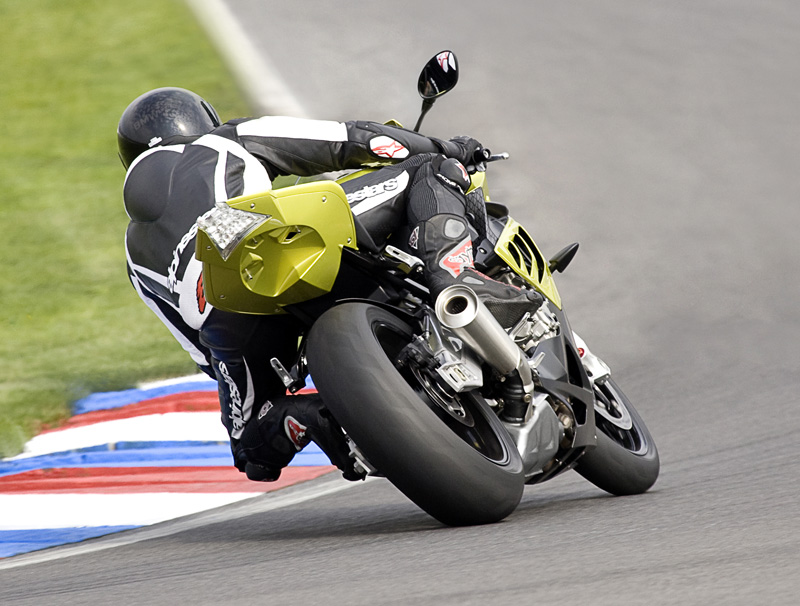
The front direction indicators come off easily and quickly for racing the S 1000 RR on the track. Similarly, the numberplate support including the rear direction indicators and numberplate light may be removed very quickly, simply by pulling a plug and unscrewing three fastening bolts.

LED direction indicators for further customisation are available as an option. The LED rear light cluster comes as standard in clear glass design, use of LEDs instead of conventional bulbs ensuring reliable and maintenance-free operation and offering a much longer service life.


Source: BMW Motorrad


Motorbikes

sports cars

Jetskis

Submersibles

power boats

Helmets |  4x4 and SUVs |  Modified Cars |  Luxury Cars |  Rare and Classic Bikes | Rare and classic Cars | Scooters

Home page   |  Contact  |  About   |   Site map